
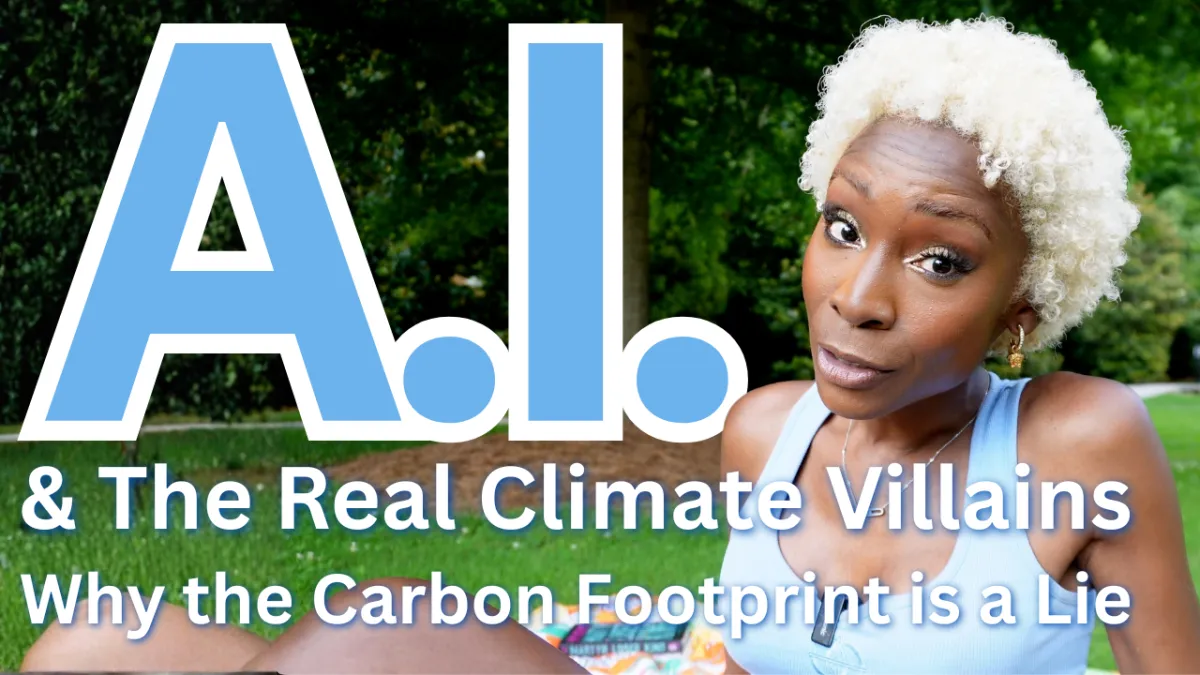
AI & The Real Climate Villains: Why the Carbon Footprint is a Lie
There is a story being told right now about who is responsible for destroying our planet. It was designed to make you feel guilty. To keep your eyes on your own small choices. To distract you from a massive, systemic shift happening right under our noses.
I'm Angelica Ross. Actor, Advocate, Nichiren Buddhist, and right now, the Deputy Campaign Manager for Dr. Butch Ware's Green Party Campaign for Governor of California. And in that work, inside environmental justice spaces, inside social justice spaces, I've been watching something troubling play out in real time.
We are so busy policing each other's individual choices that we keep missing the systemic villains hiding in plain sight.
It's time to talk about it.
The Lie They Sold Us: Who Invented Your "Carbon Footprint"?
When was the last time you felt guilty for forgetting a reusable bag? For taking a flight? For eating a burger?
That guilt didn't happen by accident. It was manufactured.
The term "carbon footprint", the very concept that places the weight of climate responsibility on individual consumers wasn't created by scientists or environmentalists. It was popularized in the early 2000s by British Petroleum. BP. One of the world's largest fossil fuel producers hired a top advertising firm and spent millions reframing a systemic, industrial problem as a series of personal moral failures.
They gave us a calculator. We calculated our hamburgers and plastic straws. And while we were busy judging each other at the potluck, the real engines of planetary destruction kept turning.
That was the blueprint. And we are watching it play out again right now with the rise of Artificial Intelligence.
The Vertical Spike Nobody Is Talking About
For about 15 years, energy consumption in the United States stayed relatively flat. We were getting more efficient. Climate scientists were cautiously optimistic.
That era is over.
Energy demand projections are suddenly going vertical, and utility companies are scrambling to keep up. The reason is data centers, the massive physical infrastructure behind every AI tool you've ever used. ChatGPT. Midjourney. Claude. The computational demands of these models are orders of magnitude beyond anything we've built before.
Here's what that looks like in real numbers:
The International Energy Agency projects that global electricity demand from data centers could double by 2026.
Global data center consumption is on track to approach the total energy usage of the entire country of Japan.
Because clean energy infrastructure can't be built fast enough, companies are turning back to fossil fuels. In Mississippi, a utility company reversed plans to retire a coal plant specifically to serve a new data center.
Read that last one again.
AI Is Thirsty And Communities Are Paying for It
The energy story is the one that gets attention. But there's another cost that tech companies have fought hard to keep secret: water.
Data centers run hot. The most common cooling method at scale is evaporative cooling and that water doesn't get treated and returned to the water supply. It evaporates. It's gone. Permanently removed from the local ecosystem.
One large-scale data center can consume up to 5 million gallons of water per day— roughly the same as a town of 50,000 people. Research suggests that a single conversation with an AI chatbot, about 25 to 50 questions, effectively consumes a 500ml bottle of water.
In Dallas, Oregon, it took a multi-year legal battle for a local newspaper to force Google to disclose that it was consuming more than a quarter of the entire town's water supply.
This is happening during historic droughts. During wildfire seasons. In communities that are already water-stressed.
This Is Environmental Racism. Say It.
Here is the part of this conversation I refuse to let get buried: where these data centers are being built is not random.
They are not going up in wealthy, protected enclaves. They are being sited deliberately in communities that already carry disproportionate environmental burdens. Black communities. Brown communities. Low-income communities.
In Memphis, Tennessee, Elon Musk's xAI is running what the NAACP callsan illegal power plant— 27 unpermitted natural gas turbines powering its Colossus data center. The facility sits near Boxtown, a community that is 90% Black with a median income of $36,000— and Memphis had already been named an "asthma capital" before xAI showed up. The NAACP is now in federal court demanding xAI shut the turbines down.
In Mississippi, a coal plant at Plant Victor J. Daniel —which had been officially scheduled for retirementand celebrated by environmentalists —had its closure reversed specifically to power incoming data center demand. Nationally,at least 17 fossil fuel generators scheduled for closure are now delayed, with data centers cited as the reason.
In South Carolina,power plants are being built in predominantly Black communitiesto keep up with data center energy needs. By 2040,the state projects it will need four new fossil fuel power plants— all driven by data center demand. Meanwhile,Black residents in South Carolina use the least electricity of anyone in the state, yet pay the highest energy burden— meaning the largest share of their income goes toward energy bills.
In The Dalles, Oregon, it took a 13-month legal battle forThe Oregonian newspaper to force Google to disclose its water usage — which turned out to be a quarter of the entire city's water supply, having nearly tripled in just five years.
This is not coincidence. This is a pattern of environmental racism hiding behind the language of innovation and the future. Stop Punching Sideways
I need to say something directly to my social justice comrades especially those in environmental spaces.
I have been in rooms (good rooms) full of people who genuinely love this earth and genuinely love oppressed communities and watched us shame each other for using free tools while the corporations building the infrastructure that actually powers those tools go completely unchecked.
We are doing BP's job for them.
Horizontal hostility is a trap. When we police each other's "AI carbon footprints," we are punching sideways at our allies instead of punching up at the architects of the system.
Precision matters. Our fight is not with the individual user. It is with the unregulated expansion of data centers. The revival of fossil fuel infrastructure. The deliberate placement of pollution in vulnerable communities. The corporate refusal to disclose consumption data.
That is what we are fighting.
What We Can Actually Do
Follow the infrastructure. The climate battle is happening at local utility boards and zoning meetings. That's where these data centers get approved.
Demand transparency. Tech companies must be forced to publicly disclose their water and energy consumption. We cannot fight what we cannot see.
Center environmental justice. "Innovation" cannot be an excuse for poisoning marginalized communities. Ever.
Hold the architects accountable. Sam Altman. Mark Zuckerberg. Elon Musk. Their digital dreams have a very physical, very toxic footprint.
The climate crisis is real. AI's role in accelerating it is a serious, growing threat. But we cannot solve this by falling for the same tricks that have always been used against us.
It's time to stop calculating our straws and start looking at the system.
Watch the full video premiering TONIGHT Tuesday June 2nd at 9pm ET →
— Angelica Ross